
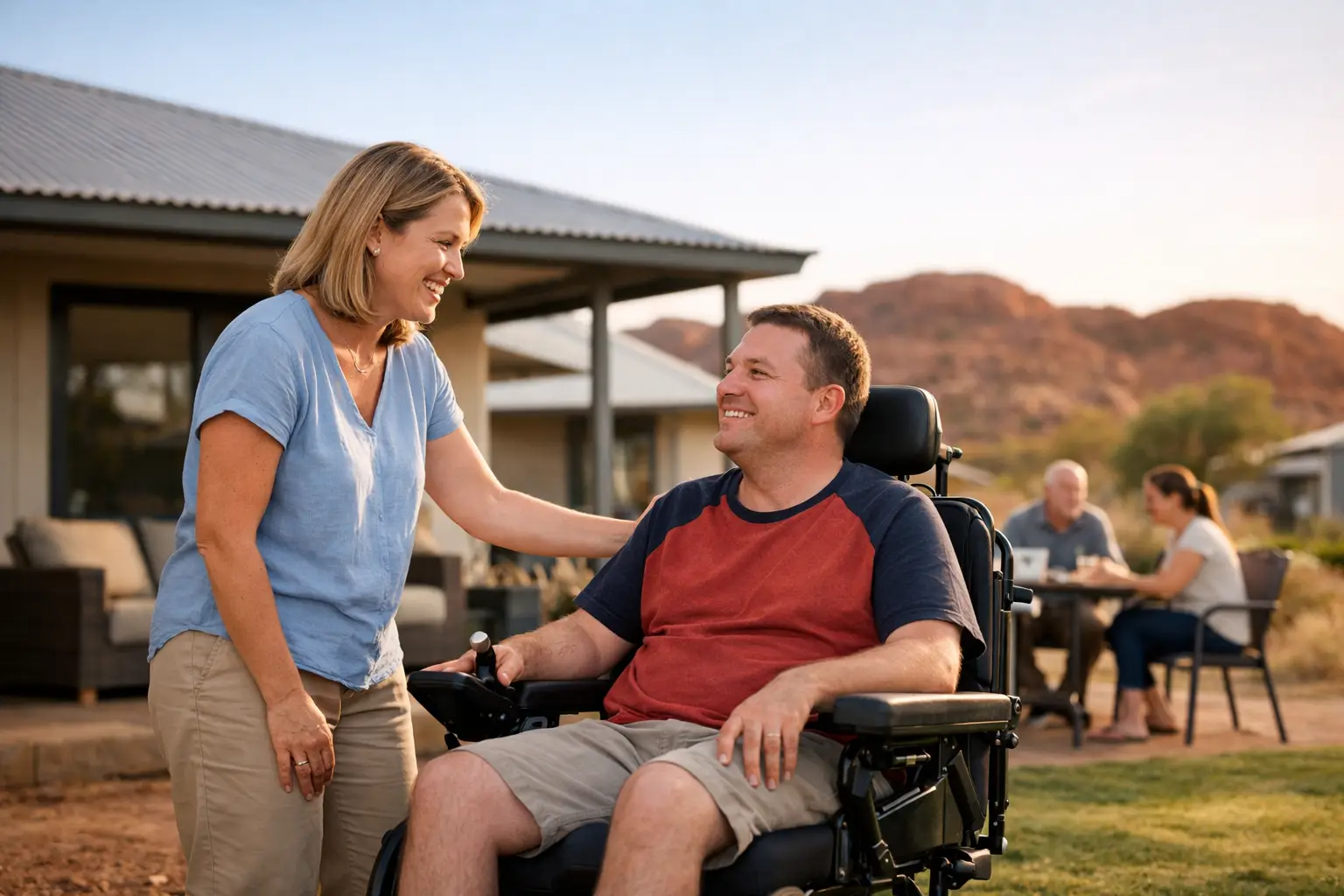
Finding the right Pilbara disability accommodation is rarely just about four walls and a roof. In regional and remote areas, the bigger question is whether the accommodation comes with the right support, the right response times, and the right people around you when needs change quickly. For participants, families and referrers, that practical difference matters every day.
In the Pilbara, accommodation decisions often carry more weight than they do in metro areas. Distance affects access to services. Workforce availability can affect continuity of care. Urgent transitions from hospital, family breakdown, carer fatigue, or a change in behaviour support needs can leave people needing a safe placement without much notice. That means accommodation has to be more than available. It has to be suitable, responsive and sustainable.
What good Pilbara disability accommodation should actually provide
Good accommodation starts with dignity. A participant should feel safe, respected and able to live in a way that supports their goals, routines, health needs and cultural identity. But dignity in practice also depends on operational details – whether staff are trained, whether medication support is reliable, whether behaviour support plans are understood, and whether transport and community access are realistic in the local area.
For some participants, the right setting is Supported Independent Living, where daily support is built around shared or individual living arrangements. For others, Specialist Disability Accommodation may be the better fit because the home itself needs specific design features for accessibility, safety or high physical support. Short-Term Accommodation and Medium-Term Accommodation can also play an important role when families need respite, a participant is waiting on a long-term housing outcome, or discharge planning needs to happen quickly and safely.
The right option depends on the person, not the label. Two participants with similar funding may need completely different environments. One may thrive in a quieter setting with consistent routines and lower sensory demands. Another may need a more active household, 24/7 oversight, and staff experienced in high-intensity supports.
Why the Pilbara context changes the decision
Disability accommodation in the Pilbara comes with regional realities that should never be brushed aside. Travel distances can be significant. Clinical appointments may require careful coordination. Support worker shortages can affect smaller providers. Families may be balancing work, caring responsibilities and long travel times between towns or communities.
That is why accommodation choice in the Pilbara should always include a close look at provider capability, not just property availability. A home may look suitable on paper, but if the provider cannot maintain staffing, respond to urgent changes, or manage complex care safely, the arrangement may not last. Stability matters just as much as presentation.
This is especially relevant for participants with high-intensity needs, complex health conditions, psychosocial disability, behaviours of concern, or overlapping support requirements. In these situations, accommodation and support cannot be separated. A placement only works when both are built together.
Pilbara disability accommodation and support need to match
The strongest accommodation outcomes happen when housing, care planning and daily supports are aligned from the start. That means understanding not only what a participant needs today, but what could change over the next six or twelve months.
A participant leaving hospital may need temporary accommodation with personal care, nursing oversight and transport while longer-term arrangements are finalised. Someone with SIL funding may need a home where staff can support medication administration, meal preparation, behavioural strategies and community participation without disrupting independence. A participant with physical disability may need assistive technology, accessible bathrooms and enough space for equipment and manual handling.
This is where families and coordinators often feel let down by fragmented systems. One organisation manages housing, another provides care, and communication falls apart. Delays creep in. Risks get missed. The participant ends up carrying the impact. A more coordinated model reduces that pressure and gives everyone more confidence in the placement.
What families and referrers should ask before choosing accommodation
The best questions are practical. Can the provider support this person’s actual needs, not just their funding category? Can they onboard quickly if the referral is urgent? Do they have experience with complex behaviours, restricted practices, personal care, mealtime management, or clinical oversight if needed?
It also helps to ask how the provider manages continuity. Who covers shifts when staff are unavailable? How are incidents escalated? How is communication handled with guardians, support coordinators, clinicians and family members? A warm approach matters, but so does a clear operating model.
Cultural inclusion should be part of that conversation as well. In the Pilbara, culturally safe support is not a nice extra. It can have a direct impact on trust, participation and long-term stability. Participants should feel seen and respected in their home environment, and families should know that identity, community connection and personal preferences will be taken seriously.
When urgent accommodation is needed
Some accommodation decisions cannot wait for a perfect sequence of planning meetings. Hospital discharge, family crisis, carer burnout, tenancy breakdown, safeguarding concerns and emergency respite can all create immediate need. In these moments, the provider’s readiness becomes critical.
Fast response does not mean rushed care. It means having the workforce, systems and experience to assess risk, organise supports, and create a safe entry point without unnecessary delay. For participants with complex support needs, a delayed placement can lead to worse health outcomes, greater distress and avoidable disruption.
This is one reason many referrers look for providers with genuine capacity rather than limited intake windows. If a participant needs accommodation in the Pilbara, the right provider should be able to move from referral to practical planning quickly, while still keeping the participant’s preferences and safeguards at the centre.
The trade-offs to think about
There is no single perfect model of disability accommodation. Shared homes can offer companionship, cost efficiency and regular staffing, but they may not suit participants who need lower stimulation or highly individual routines. Individual arrangements can offer more privacy and flexibility, but they may require stronger staffing infrastructure and can be harder to establish in some regional areas.
Likewise, the nearest available vacancy is not always the best long-term fit. A short travel distance may help family contact, but if the support model is weak, the placement may break down. On the other hand, a provider with stronger clinical capability and better continuity may offer a more stable outcome, even if logistics need more planning.
That is why accommodation should be assessed through both a human lens and an operational one. The home needs to feel right, but the service behind it also needs to hold up under pressure.
Building independence through the right environment
Good accommodation should never reduce a person to their support needs. The aim is not simply to keep someone housed. It is to help them live with more confidence, safety and control.
That may mean supporting daily living skills, building routines, improving community participation, or creating a calmer and more predictable environment. For some participants, success looks like learning to manage more of their own day. For others, it means having high-quality support that protects health and wellbeing while preserving choice and dignity.
A capable provider understands that independence is not one fixed idea. It looks different for each person. In practice, real independence often grows when the environment is stable, support workers are consistent, and families trust that care will continue even when circumstances change.
For regional communities, that reliability can be the deciding factor. Treasure Disability Care is built to respond where capacity is often the biggest barrier, with support models designed for complex needs, urgent referrals and accommodation pathways that do more than fill a gap.
Choosing Pilbara disability accommodation is a significant decision, but it should not feel like a gamble. With the right mix of housing, support capability and respectful planning, accommodation can become the place where stability returns and progress starts to feel possible again.